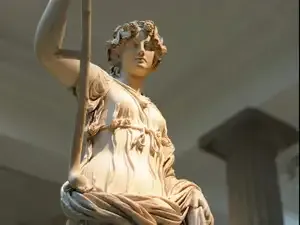
Minerva, the Roman goddess of poetry, medicine, wisdom, commerce, weaving, crafts, and magic. Image credits: Wikimedia Commons
A farmer in rural Oxfordshire had, for more than a decade, kept a small bronze figure in an old margarine tub, alongside a handful of coins, assuming it was a modern fake. It turned out to be a nearly 2,000-year-old statue of Minerva, the Roman goddess of wisdom. The farmer had found the statue himself years earlier while out on his own land, and, believing it to be worthless, had stored it away in the margarine tub, where it stayed for more than ten years, according to a 2019 Current Archaeology news article. In an age that promotes decluttering, it’s a reminder that authentic artefacts can hide in plain sight.
The discovery that almost stayed a kitchen curiosity
In 2018, Len Jackman, a 66-year-old retired truck driver and amateur treasure hunter, asked the farmer for permission to search his land with a metal detector, as reported in a 2018 CNN publication. The farmer mentioned he had other old finds lying around the house and produced the margarine tub, telling Jackman the statue inside had been found on his land. As an experienced detectorist, Jackman suspected the figure was Roman and took it, along with other artefacts from the farm, to be identified.
This statue had survived the fall of the Roman Empire, centuries of English weather, and at least one spring clean. This would have made any thrift-store shopper speechless. We all love a good thrift store bargain and watching videos of "is this worth anything?" but this was, remarkably, an actual Roman god.
How the artefact was discovered
The artefact was taken to the Portable Antiquities Scheme in England, an initiative run by the British Museum to record artefacts found by the public, in this case, at the Museum Resource Centre in Standlake. The statue was recognised by another treasure hunter and passed on to the Finds Liaison Officer in the local area. It was then recorded in the National Database with the reference OXON-7B00CD, as per Current Archaeology. Dating back to around AD 43-200, this puts the statue back into the early years of Roman rule in Britain.
In the UK there is a set process in place for artefacts such as this. The Treasure Act allows for museums to have first refusal on artefacts. There is nothing similar in place in the USA for items found on private land. This is why so many artefacts in the USA get stuck in legal limbo. This find, recovered not from the ground, but from a margarine tub in a farmhouse, has underlined the importance of recording artefacts even when their origin seems unlikely.
Who was Minerva?
Minerva was not a minor deity. She was the Roman equivalent to the Greek goddess Athena. She presided over wisdom, strategy, medicine and the arts. She was one of the three most important Roman gods, along with Jupiter and Juno, known as the Capitoline Triad. Research into the religious beliefs of Roman Britain shows how far Minerva’s cult spread. Research has shown that Minerva is frequently mentioned in votive inscriptions across the province. A 2024 study titled “The Agency of Civilians, Women, and Britons in the Public Votive Epigraphy of Roman Britain,” published in the journal Internet Archaeology, states that she was often worshipped by the people of Britain alongside other Greco-Roman deities and sometimes blended with local gods. This shows how the Romans used Minerva to create their own identity in Britain.
Why this story keeps popping up online
The story has an enduring appeal: the idea that something valuable might be sitting unnoticed in an old container at the back of a cupboard. It also shows how archaeology can hide in plain sight. The next time you’re tempted to throw away an old item, it may be worth a second look, Minerva certainly proved worth one.
The discovery that almost stayed a kitchen curiosity
In 2018, Len Jackman, a 66-year-old retired truck driver and amateur treasure hunter, asked the farmer for permission to search his land with a metal detector, as reported in a 2018 CNN publication. The farmer mentioned he had other old finds lying around the house and produced the margarine tub, telling Jackman the statue inside had been found on his land. As an experienced detectorist, Jackman suspected the figure was Roman and took it, along with other artefacts from the farm, to be identified.
A raised-relief image of Minerva on a Roman gilt silver bowl. Image credits: Wikipedia
How the artefact was discovered
The artefact was taken to the Portable Antiquities Scheme in England, an initiative run by the British Museum to record artefacts found by the public, in this case, at the Museum Resource Centre in Standlake. The statue was recognised by another treasure hunter and passed on to the Finds Liaison Officer in the local area. It was then recorded in the National Database with the reference OXON-7B00CD, as per Current Archaeology. Dating back to around AD 43-200, this puts the statue back into the early years of Roman rule in Britain.
A head of Sulis-Minerva at The Roman Baths. Image credits: Wikimedia Commons
Who was Minerva?
Minerva was not a minor deity. She was the Roman equivalent to the Greek goddess Athena. She presided over wisdom, strategy, medicine and the arts. She was one of the three most important Roman gods, along with Jupiter and Juno, known as the Capitoline Triad. Research into the religious beliefs of Roman Britain shows how far Minerva’s cult spread. Research has shown that Minerva is frequently mentioned in votive inscriptions across the province. A 2024 study titled “The Agency of Civilians, Women, and Britons in the Public Votive Epigraphy of Roman Britain,” published in the journal Internet Archaeology, states that she was often worshipped by the people of Britain alongside other Greco-Roman deities and sometimes blended with local gods. This shows how the Romans used Minerva to create their own identity in Britain.
Why this story keeps popping up online
The story has an enduring appeal: the idea that something valuable might be sitting unnoticed in an old container at the back of a cupboard. It also shows how archaeology can hide in plain sight. The next time you’re tempted to throw away an old item, it may be worth a second look, Minerva certainly proved worth one.