If you wanted an idea of the health of darts right now, you could do worse than look at the ticket sales for the 2026 PDC World Championship. Anyone curious about snapping up a last-minute table is out of luck, with standard tickets for the upcoming event selling out in less than 24 hours.
With that in mind, might it be time to move the tournament away from its iconic Ally Pally home? If you were to base a decision on capacity alone then it might look like an easy one, but PDC CEO Matt Porter doesn’t see things as quite so black and white.
Indeed, shortly after Porter spoke exclusively to Mirror Sport , the PDC confirmed an extension of its Ally Pally deal until 2031. Even before then, though, the CEO gave the rationale for passing up on bigger crowds to keep the iconic tournament at its iconic home.
“It's already not big enough in its current format,” Porter says, but he recognises the concept of ‘big enough’ depends on exactly what you want to achieve. “The event sells out on day one, and you want to sell out but you don't necessarily want to sell out in five seconds flat because you don't want to be leaving thousands of people disappointed that they couldn't get tickets,” he adds.
“So it's something we're looking at. Ally Pally's been a great partner of ours for pretty much two decades now and an iconic home for the event, and I think we have to balance the commercial needs with the sporting... and the legacy appeal as well.
• World Darts Championship: Start time, streaming details and Luke Littler's first match
• Luke Humphries' true feelings on Luke Littler speak volumes ahead of World Championship
“Ally Pally's a very popular venue. People enjoy their annual pilgrimage there, they come from all over the world to visit it and you wouldn't want to lose that.
“Wimbledon could probably sell twice as many tickets to the finals of their event if they moved from Centre Court but they're not going to do that. Could the FA sell more tickets for the FA Cup final if they moved to a 130,000 seater stadium somewhere? Probably, but they're not going to do that.
“Is Lord's big enough for the Ashes? Probably not, but all these venues are iconic and they're synonymous with their events, and Ally Pally fits into that bracket for us too.”
It’s a venue where memories are created, for the fans and for the players, and this year will be no different. Luke Littler became the youngest ever world champion last year when he bulldozed Michael van Gerwen in the final.
It’s easy to forget quite how young Littler is - he won’t turn 19 until a couple of weeks after the 2026 final - given how composed he is at the oche. And this composure means Porter isn’t overly concerned about having to wrap the champ in cotton wool.
“He shows maturity and composure beyond his years and he has done, really, since he broke through onto the scene,” Porter says of Littler “So there's of course always an element of working with his management and his family to ensure that an appropriate environment is created for him, but he's very capable of dealing with the environments that are in front of him. Whilst we're obviously very conscious of the need to manage his welfare and all other player welfare, there's no real cause for concern on that front because of the maturity he shows.
“He's quite a shy, quite a quiet lad - he's not hugely outgoing - but that doesn't mean he's nervous or anything like that. He's very confident and very composed.”
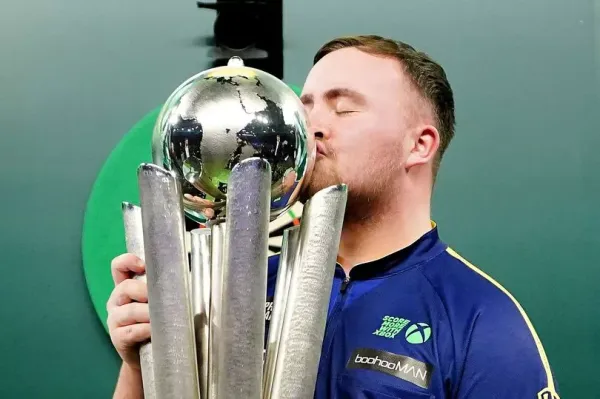
We’ve seen Littler’s relaxed side at other events throughout the year, not least at Premier League Darts, which brought 150,000 attendees across its 17 nights in 2025. The tournament hasn’t just been lucrative for the PDC and the players involved, with impressive prize money on the line week on week - it’s also become a weathervane when it comes to the present and future of darts’ elite.
Littler is the obvious success story when it comes to building the next generation, but he isn’t the only one. Gian van Veen added his name to the list of major final winners when he won the European Championship in October, while it’s easy to forget that even some of the more experienced stars have traded in peaks and troughs before arriving at the point they are now.
“The top end of darts continues to evolve, and it doesn't get stale, because there is always new talent emerging,” Porter says when asked about future-proofing the product. “[Luke] Humphries has only been at the top of the game for a few years, people like [Gerwyn] Price and [Stephen] Bunting have had resurgences, obviously Littler's there. So there's always enough evolution in the sport to keep audiences fresh, which is good because the last thing you want is to have a stale product that people get bored of.
“Obviously they need to have the ability and the mentality to deal with [these] matches. Obviously you want players with personality, you want players with stage presence, you want players who have a good profile amongst the public and the media and are generally going to reflect well on the sport and be good ambassadors for the sport. So it's the whole package really.”
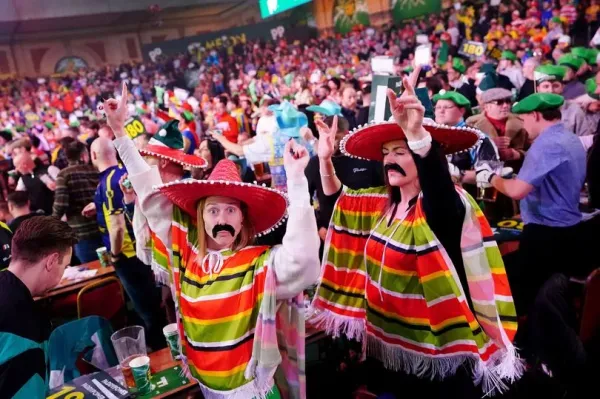
Has there been an element of players giving each other a helping hand in establishing their respective niches? If that’s the case, Porter says, it’s happened in an organic way.
“I don't think they so much show each other as learn from each other,” he says. “Every player needs to have their own personality - you couldn't copy what Peter Wright does, for example.
“You look at Gerwyn Price, three or four years ago the crowd were… on Gezzy's back whereas he's turned them round and now he's as popular as many of the other players. So I think it's about carving out your own niche, having your own personality and your own profile, and people will feed off that.”
Planning for the future takes other forms, too. The PDC is moving into new territories and bringing in new commercial partners - “more than just the traditional bookmakers and breweries,” Porter recognises, while emphasising those partners still remain important and valued.
Existing TV deals mean darts is often already popular in new territories before tournaments follow suit. Some prevent unique challenges, though, not least Saudi Arabia - where the PDC will be heading for the first time in January.
“The look of the event aesthetically, the stage, the concept of the sport, et cetera, will all be the same. But clearly the crowds will take on a different form,” Porter says. “In the first year you wouldn't expect there to be necessarily thousands of people there and the atmosphere may be slightly different to what people are used to seeing on TV.
“Everywhere we take the sport to, we want to leave a legacy and develop and interest in darts, and they're all different. It's perhaps not the most widely played sport in the country at the moment but it's a sport with very few barriers to entry and there's no reason why people in Saudi can't take the game up in the same way that people in many other countries have done.”
At the sport’s heart, it comes back to the fans. Darts is and always has been a social sport, for those taking part and those observing from the sidelines, and Porter sees no reason why new territories can’t - in time - develop that fans-first strength we’ve seen over the years in the UK.
Looking ahead to the Worlds, though, is there anything he’s looking out for? There are always likely to be good individual stories, with an expanded field of 128 players giving more opportunities, but it’s about more than that.
“I think ultimately the results will look after themselves and the matches will look after themselves, but we'll know we've done our job if people leave with a smile on their face and they tune in on TV day after day,” he says. “It sounds a bit corny but ultimately that's what we're there for.”