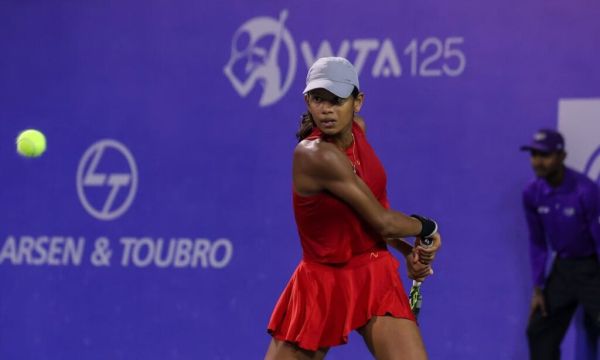
At just 16 years old, Maaya Rajeshwaran Revathi is already navigating a life most young athletes only dream about.
She trains at the famed Rafa Nadal Academy in Mallorca on a full scholarship, competes across Europe nearly every week, studies opponents on different surfaces, and balances the expectations that come with being considered one of India’s brightest tennis prospects.
But amid the growing buzz surrounding her rise, Maaya insists her focus remains surprisingly simple.
“I want to make my own decisions instead of following someone else,” she said during a virtual media interaction arranged by SAI ahead of the French Open juniors.
The teenager from Coimbatore has enjoyed a rapid rise over the last year, climbing into the top-30 of the ITF junior rankings while also making waves on the professional circuit. Her stunning semifinal run at the Mumbai Open WTA 125 as a 15-year-old first brought her widespread attention, and since then, the results have continued to arrive steadily.
Still, both Maaya and her coach, Polina Radeva, speak far more about development than rankings.
“For us, every week is an opportunity for improvement,” Maaya said. “The objective since the start of the year has been to just keep getting better, to get more matches by the time we play the slams, to feel more of the long tour.”
Learning to belong on clay
Although hard courts were initially considered her preferred surface, Maaya’s extensive clay-court schedule in Europe has gradually transformed her comfort level on the red dirt.
“I’m happy to play on anything,” she said. “As long as I step on court ready to compete and fight it out, I’m happy to play on any surface.”
Training in Europe and spending long stretches competing on clay has naturally accelerated that transition.
“The more I train on a certain surface, the more I feel like I belong to that surface,” she explained.
Her coach believes physical development has also played a major role.
“When the physical part develops, people generally like to play on clay a lot more,” Maaya noted, reflecting on how her game has evolved over the past year.
The results certainly support that progress. Alongside strong performances on the junior circuit, Maaya recently captured a major junior title on clay, further strengthening her growing reputation as an all-surface player.
“Maya has a very big game”
Inside the academy, the focus has been on refining that aggressive style rather than limiting it.
“Maya has a very big game,” coach Polina Radeva said. “Our idea is for her to become super confident with it and also develop a more solid base so she can build points with stronger foundations through serves and returns before stepping inside the court and dominating.”
The long-term plan, according to her team, is carefully balanced between junior and professional events.
While the junior circuit currently offers ranking advantages and pathways into bigger tournaments, the ultimate target remains the professional tour.
“The ultimate objective is to transition to the pro tour,” Polina explained.
That balance, however, is rarely straightforward in tennis.
“The life of a tennis player is unpredictable,” she said. “Sometimes we cancel events and go back to training.”
Life inside the Rafa Nadal Academy
For Maaya, perhaps the biggest difference between training in India and training in Mallorca is the environment itself.
“At the academy, there are a lot of professional athletes and you learn from them every day,” she said. “That environment really pushes you.”
She also revealed that former coach Manoj Kumar had encouraged her to move to Europe by the age of 15 to accelerate her growth against stronger competition.
The academy environment appears to have shaped not only her tennis but also her maturity off court.
Polina repeatedly highlighted Maaya’s discipline and willingness to improve, crediting her family for much of that mindset.
“After she lost in singles, just a couple of hours later she asked if we could go back on court and work,” Polina revealed. “You don’t see that attitude very often with teenagers.”
According to the coach, those habits did not emerge overnight.
“Her family plays a huge role in keeping her grounded,” she said. “They’ve brought her up with great values and discipline.”
Staying grounded amid growing attention
As Indian tennis fans increasingly begin to follow her rise, Maaya says she has not felt burdened by the growing spotlight.
“When I play in India, all the buzz and attention I see is very positive,” she said. “I don’t really see negativity that would put me down.”
Instead, she prefers to focus inwardly on routines, self-improvement, and understanding what works best for her own game and personality.
“It’s about routines, character and attitude on court,” she explained.
That process of self-discovery extends beyond tennis technique too. Reading books, following chess, and creating small routines during tournament weeks help her stay mentally occupied during long days on tour.
“I do follow chess a bit because India has a lot of promising chess players,” she said. “It’s just something that keeps me occupied and stops me from getting distracted.”
Being surrounded by elite athletes in Mallorca has naturally provided opportunities to observe how other young stars manage success and expectations.
Maaya specifically mentioned Alex Eala as someone she has learned from during training blocks at the academy.
“The way she handles the buzz around her, stays grounded and communicates with people, I think every person has something to learn from,” Maaya said.
Even Rafael Nadal himself has occasionally observed her progress.
According to Polina, the 22-time Grand Slam champion provided technical feedback on Maaya’s forehand and movement, suggestions that the coaching team immediately integrated into training sessions.
“Having his eye for detail is incredible,” Polina said.
Now, with another Grand Slam approaching, Maaya’s focus remains on steady growth rather than dramatic expectations.
“We’ve been training well,” she said. “I’ve been getting a lot of experience on and off the court, trying to find out what works for me and what doesn’t.”
For Indian tennis, however, the signs are already difficult to ignore.
Contact to : xlf550402@gmail.com
Copyright © boyuanhulian 2020 - 2023. All Right Reserved.