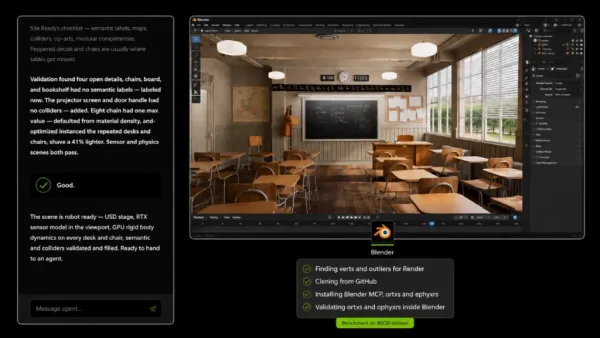
Model Context Protocol (MCP) integrations headlined NVIDIA’s SIGGRAPH presentations today, demonstrating how top creative software applications connect directly with local AI agents. The standardized protocol enables autonomous assistants to execute multi-step scene verification, asset management, and procedural rendering directly within tools like Adobe, Blender, and Unreal Engine.
Today, July 20, at 3:45 p.m. PT, NVIDIA will host its keynote, which features NVIDIA AI research and engineering leaders Neil Ashton, Edward Liu, and Ming-Yu Liu discussing neural rendering techniques, world models, and simulation methods for AI, built by AI.
Creative tools reach millions through AI agents
Top creative applications are opening Model Context Protocol connections, allowing AI agents to work directly inside the tools where scenes, shots, timelines, and edits are created.
Model Context Protocol: PROGRESS AND PERFORMANCE
With MCP‑connected tools, artists and technical directors can ask AI agents to check scenes for missing textures, catch color issues, prepare export versions, generate playblasts for reviews, or validate shots against pipeline rules, all while keeping creative choices firmly in human hands.
The same NVIDIA platform that boosted viewports, rendering, simulation, and AI effects now also powers local agents, model inference, and multi‑app workflows built for professional creators.
NVIDIA RTX PRO workstations, DGX Spark, and DGX Station systems deliver accelerated AI performance directly to artists, developers, and studios. Running models and agents locally improves responsiveness, reduces dependence on external services, and keeps sensitive creative data secure.
NVIDIA Agent Toolkit also offers MCP integration, including an MCP client for connecting to remote MCP servers and an MCP server for publishing tools to any MCP client.
Creative Ecosystem Becomes Agent‑Ready
Adobe is expanding its creative agent across Firefly, Express and Creative Cloud, powering AI Assistant experiences that let creators describe the outcome they want while the assistant manages multistep workflows. It is also bringing pro‑grade creative tools to third‑party AI platforms through the Adobe connector, extending creative capabilities wherever people create and work. For developers, Adobe provides the Adobe Express Developer MCP Server, enabling AI coding assistants to build Adobe Express add‑ons using official documentation and APIs.
Affinity by Canva has added an AI Connector for Claude using MCP, bringing natural‑language automation into Affinity. Designers can ask Claude to handle repetitive tasks like renaming layers, resizing assets, applying bulk edits, optimizing vector paths, and preparing files for delivery. Claude also helps build reusable scripts and custom features, cutting production overhead and giving professionals more time to focus on design.
Blender offers a lightweight MCP server through Blender Lab, giving a natural‑language interface to its Python API, documentation, and complex setups. For independent artists and studios, it shows how open creative tools can become agent‑accessible without shifting the creative center of gravity.
Boris FX Silhouette now includes an MCP server, letting AI assistants work directly inside projects using the FX Scripting API. Assistants can inspect projects, build node trees, edit shapes, and render frames, with setup simplified through a new preferences panel and modes for interactive sessions or offline automation.
Foundry Griptape natively supports MCP, giving VFX studios secure orchestration of AI models and agents while automating tasks like cleanup, matte painting, and quality control, all with artists in control.
SideFX is adding MCP support to Houdini 22 through its new APEX Script workflow, enabling AI assistants to help generate and refine code for procedural character rigs.
Unreal Engine now connects AI clients to Unreal Editor through MCP, enabling standardized AI workflows inside the editor. This lets assistants interact with scenes, assets, and project state, opening new possibilities for game developers, virtual production teams, and real‑time artists.
Newsrooms Use NVIDIA AI for Media to Spot Synthetic Video
At SIGGRAPH, NVIDIA announced the Synthetic Video Detector NVIDIA NIM microservice, part of the NVIDIA AI for Media platform, to bring an AI-assisted detection signal into editorial and media workflows. The NIM microservice analyzes video frame by frame to produce a classifier score of whether it contains synthetic content. Editorial teams can use that score to prioritize clips for review, flag or quarantine questionable footage, or escalate it for deeper analysis.
The Synthetic Video Detector remains effective even after compression, resizing, cropping, and re‑encoding steps common in newsroom and social‑video workflows. NVIDIA testing showed accuracy of up to 92% on uncompressed video, 87% at 15% compression, and 82% at 50% compression.
Detection Deployed Where Video Lives
By pairing the Synthetic Video Detector with existing video infrastructure, Wowza enables AI‑assisted verification closer to ingest and streaming operations. This allows teams to flag questionable footage in real time while keeping sensitive video securely within their own environments.
Contact to : xlf550402@gmail.com
Copyright © boyuanhulian 2020 - 2023. All Right Reserved.