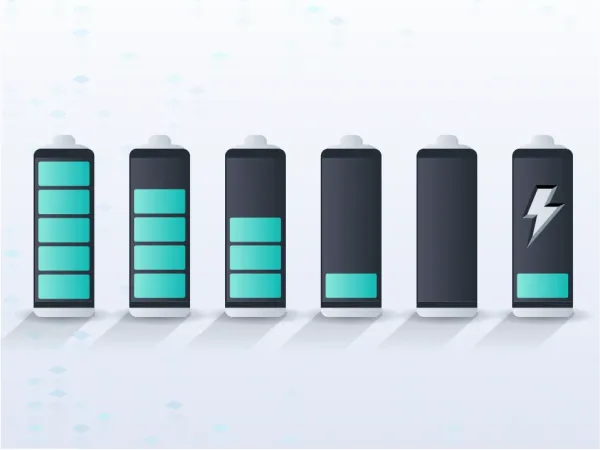
If you own a smartphone, laptop, or EV, chances are you have witnessed how battery health deteriorates from 100% to 90% or even less within a couple of years. However, the question is: How come Battery Health Declines despite your best attempts at caring for your electronic device?
The reason for battery health deterioration is that the energy in batteries works on chemical reactions that are imperfect and non-permanent. Gradually, such reactions affect the inner structure of the cells, thus reducing its capacity and efficiency.
This article will examine the reasons for battery health decline, factors accelerating this process in day-to-day use, and ways to prevent it.
What Is Battery Health?
Before we ask why battery health declines, we should understand what “battery health” means.
Battery health is the measure of how much charge a battery can hold compared to when it was new. When a battery is fresh from the factory, it has 100% of its designed capacity. After a few years of use, that capacity drops. Your phone might show 85% battery health. That means it can now store only 85% of the original charge.
This number is different from the battery percentage on your screen. Battery percentage shows how much charge is left right now. Battery health shows how much the battery can hold in total. A battery with 80% health still charges to 100%, but the “100%” now represents a smaller tank.
Inside a Lithium‑Ion Battery
To explain why battery health declines, we need a simple view of what is inside a modern battery. Most phones, laptops, and EVs use lithium‑ion batteries.
A lithium‑ion cell has three main parts:
- Anode: often made of graphite.
- Cathode: made of lithium‑based metal oxides.
- Electrolyte: a liquid or gel that lets lithium ions move between anode and cathode.
When you charge the battery, lithium ions move from the cathode to the anode and stay there. When you use the device, they move back to the cathode. This flow of ions creates the electric energy that powers your device.
These movements are not perfect. Some ions get trapped, some side reactions happen, and materials change shape. Over thousands of cycles, these tiny changes add up and explain why battery health declines.
Why does Battery Health Declines: Core Aging Processes
There are two main ageing processes in lithium‑ion batteries: cycle ageing and calendar ageing. Both work together, and both explain Why does Battery Health Declines even in normal use.
Cycle Aging: Charge and Discharge Wear
Every time you charge and discharge the battery, you run one part of its lifespan.
A “cycle” does not always mean one full 0% to 100% discharge. If you use 50% of the battery twice, that also counts as one full cycle. Over hundreds of cycles, the materials inside the battery expand and contract. This movement creates stress.
With time, this stress leads to:
- Small cracks in the electrode material.
- Loss of contact between particles.
- Reduced active area for reactions.
This means less material is available to hold lithium ions. So the battery can store less energy. Cycle ageing is a key reason why battery health declines for heavy users who charge often.
Calendar Aging: Time Damage Without Much Use
Even if you do not use the battery much, it still ages. This is called ‘calendar ageing’.
Chemical reactions continue at a slow pace even when the battery sits in a drawer. Some side reactions consume lithium. Some slowly change the electrolyte and electrode surface.
Calendar aging speeds up when:
- The battery stays at high charge levels for long periods.
- The battery stays in hot environments.
This explains why battery health declines even if you have a backup phone that just sits fully charged in a warm place. Time alone, combined with chemistry, wears it down.
Why does Battery Health Decline Faster in Heat?
Heat is one of the strongest reasons why battery health declines so fast in many devices.
High temperature speeds up every chemical reaction. This includes useful reactions and harmful side reactions. In a hot battery, the electrolyte breaks down faster and the protective layers on electrodes grow thicker and less stable.
Heat causes:
- Faster loss of active lithium.
- Growth of resistance inside the cell.
- Higher risk of gas formation and swelling.
In daily life, this happens when you:
- Game or stream video while charging.
- Leave your phone in a hot car or under the sun.
- Use a laptop on a soft surface that blocks airflow.
Heat and cycling together explain many cases where users ask why battery health declines sharply in the first two years.
Low Temperature and Battery Health
Cold temperatures matter in a different way. Cold often makes the battery feel weak in the moment, but it also can affect long‑term health.
In cold conditions:
- Ion movement slows.
- Internal resistance rises.
- The device can shut down early, even at moderate charge levels.
If you charge aggressively in very low temperatures, lithium can deposit on the anode surface as a metal layer. This is called lithium plating. Lithium plating can cause permanent damage and is another reason why battery health declines in devices used or charged outdoors in winter.
In simple terms: cold makes the battery “sluggish”, and wrong charging in that state can cause lasting harm.
Why Does Battery Health Decline with Extreme Charge Levels?
Running a battery at its extremes is harder on the chemistry. Both very low and very high charge levels cause stress.
Deep Discharge (Near 0%)
Letting a battery drop close to 0% again and again stresses the electrodes. At low charge, the structure inside can become less stable, and side reactions can grow. This kind of use is one reason why battery health declines faster in devices that are often run until they die.
High Charge (Near 100%)
Keeping a battery near 100% also hurts it. At high charge, the voltage inside the cell rises. High voltage speeds up chemical breakdown of the electrolyte and the interface layers. If a battery sits at 100% in hot conditions, this ageing can be much faster.
This is why many modern devices include features like “optimized charging” that delay the final part of the charge until just before you wake up or unplug. The goal is to reduce the time spent at 100% and slow down the rate at which battery health declines.
Doing this while charging combines both types of load and speeds up degradation further.
Why does Battery Health Declines in Smartphones and Laptops?
Phones and laptops show battery health decline more sharply because of how we use them and how they are built.
Key factors include:
- Thin designs with limited room for cooling.
- Sealed bodies that trap heat.
- High‑intensity apps like games, video, and camera use.
- Charging while using the device.
A phone in a slim metal frame can heat up quickly. There is no big heatsink or active cooling, so that heat sits near the battery. If you charge the phone while streaming or playing games, the battery stays warm or even hot. This is why battery health declines faster in such usage patterns.
Laptops can suffer in a similar way. When used on beds, sofas, or laps, vents get blocked and heat builds up. Combined with long periods plugged in at 100%, this creates a perfect setting for faster ageing.
Why does Battery Health Declines: Common User Habits
Many everyday habits speed up battery ageing. These habits answer in a practical way Why does Battery Health Declines faster for some users than others.
Common causes include:
- Charging your device at 100 percent in a hot environment for an entire night.
- Consistently draining your battery to below 0 percent.
- Rapidly charging your battery multiple times in a single day.
- Utilizing low-quality chargers providing inconsistent power.
- Gaming or streaming videos while charging your device.
- Keeping devices fully charged in hot environments.
Even when two friends purchase the same mobile phone on the same day, after two years, one could be at 90 per cent, whereas the other could be at 80 per cent. The reason could be these mistakes.
How to Slow Down Battery Health Decline
The good news is that you can change how fast battery health declines. You cannot stop ageing, but you can slow it.
Here are simple actions:
- Stick to the middle: Try to maintain the charge level between 20% and 80%.
- Avoid extremes: Don’t leave the device with either zero or one hundred percent charge for an extended period of time.
- Cool down: Protect the device from high temperatures and keep it cool; do not use the device excessively while it is being charged.
- Get appropriate chargers: Purchase genuine or compatible chargers that suit the power characteristics of the device.
- Avoid fast charging: Utilize fast charging when it is necessary, and use slower methods when possible.
- Optimize the battery charging process: Turn on the optimized battery charging function.
These steps directly tackle the main reasons why battery health declines and help your device last longer.
Can Battery Health Improve Once It Declines?
Many users hope to “restore” battery health. In practice, true chemical health does not improve.
You can:
- Recalibrate the battery gauge by doing a full charge and discharge under calm conditions.
- Clear misreadings in the software.
This can make the reported battery health number more accurate. Sometimes it looks like the health went up a bit. But the underlying chemical wear remains. Once lithium is lost or material is damaged, the process is permanent.
So, if you ask why battery health declines and whether it can reverse, the honest answer is that ageing is one way. You can slow it but not undo it.
What You Can Do
Battery health becomes worse owing to the complexity of chemical reactions that undergo changes in time. There are several factors that influence them, including cycles, age, temperature, charge states, fast charging, and user behaviour.
It is impossible to prevent aging; however, it is possible to influence it. You just need to keep your battery cold, avoid extremes, and charge correctly. And for those who use phones, laptops, and electric vehicles daily, learning about why battery health becomes worse is an essential step to using your devices in a smart manner.
Contact to : xlf550402@gmail.com
Copyright © boyuanhulian 2020 - 2023. All Right Reserved.