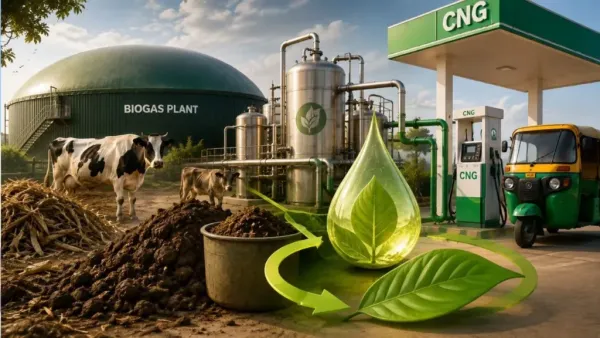
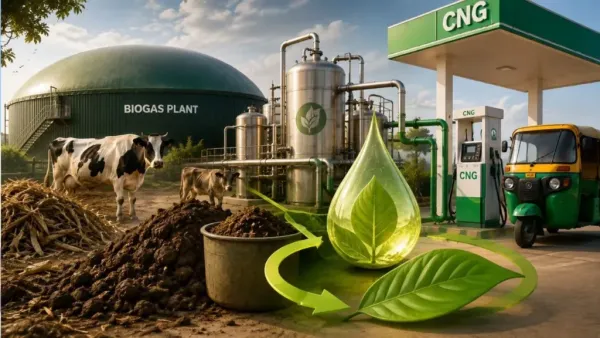
National Circular Bioenergy Scheme: The Union Cabinet, chaired by Prime Minister Narendra Modi, on Thursday approved the ₹23,731 crore “Gobardhan” (National Circular Bioenergy Scheme). The scheme will be implemented from fiscal year 2027 to 2036 and aims to increase the production of compressed biogas (CBG) in the country by almost 10 times, encourage private investment and increase farmers’ income.
The government aims to develop a strong circular bioeconomy in the country by promoting clean energy production from agricultural residues, dung and organic waste.
Farmers and investors will benefit
Under the scheme, a “CBG Offtake Assurance” system will be established for CBD producers, providing them with a reliable market for purchasing their product. Through this, city gas distribution (CGD) companies will purchase CBD in a prescribed proportion.
The government has also set targets for CBG blends:
- FY 2027: 3%
- FY 2028: 4%
- FY2029 onwards: 5% (in CNG and PNG categories)
This will strengthen the financial viability of CBG projects and encourage private investment.
10 big things about Gobardhan scheme
- The Union Cabinet, chaired by Prime Minister Narendra Modi , has approved the ₹23,731 crore
“Gobardhan” scheme. The scheme will be implemented from fiscal year 2027 to 2036. - Aim to increase CBG production 10 times
The government aims to increase the production of compressed biogas (CBG) from agricultural residue, cow dung and organic waste by about 10 times. - Focusing on increasing farmers’ income,
the scheme will provide better prices for dung and agricultural waste, providing a new source of additional income for farmers.
Under the ‘CBG Offtake Assurance’ arrangement, City Gas Distribution (CGD) companies will purchase CBG in a fixed proportion, thereby providing a stable market to producers .- The government has set a target of 3% CBG blending
in CNG and PNG in the financial year 2027, 4% in 2028 and 5% from 2029 onwards. - The administrative price of CBG has been fixed at
₹2,110 per mmBtu. This price will remain in effect for at least 10 years. - Capital assistance for new projects:
Greenfield CBG projects will receive capital assistance of up to ₹2 crore per tonne per day (TPD) of capacity. Brownfield expansion projects will also be eligible. - Expansion of pipeline network
New infrastructure will be developed to connect CBG plants to gas pipeline and CGD networks, thereby reducing transportation costs. - Easy credit facility to MSMEs:
A special credit guarantee mechanism will be created for MSME based CBG projects, so that bank loans can be easily available and the need for collateral is reduced.
The “CBG Ecosystem Challenge Fund” will promote bioenergy projects at the district level . Its objective is to strengthen the bioenergy value chain at the local level.
The government fixed the administrative cost
Under the plan, a government-supported pricing mechanism will be implemented. The administrative price of CBDG has been fixed at ₹2,110 per mmBtu. This price will remain in effect for at least 10 years, assuring producers of stable income and facilitating investment in new projects.
Capital assistance to new projects
Greenfield CBG projects will receive capital assistance of up to ₹2 crore per tonne per day (TPD) of capacity. This assistance will not only be limited to plant installation, but also:
- Feedstock Storage
- Organic fertilizer processing
- Value Addition Infrastructure
This will also apply to facilities like . Brownfield projects that enhance capacity will also be eligible for this assistance.
Pipeline and MSME will get support
Under the plan, new pipeline infrastructure will be developed to connect CBG plants to the gas pipeline network and CGD networks. This will reduce transportation costs and facilitate market access.
Further, a special credit guarantee mechanism will be created for MSME-based CBG projects, which will enable them to easily access bank loans and also reduce the need for collateral.
Challenge fund will be created at the district level
The government will also establish a “CBG Ecosystem Challenge Fund” to effectively implement the plan. Its purpose is to promote bioenergy projects at the district level and strengthen the value chain locally.
This scheme, run by the Ministry of Petroleum and Natural Gas, is being considered an important step towards better utilization of organic waste, production of clean energy and ensuring additional income for farmers in the country.
Contact to : xlf550402@gmail.com
Copyright © boyuanhulian 2020 - 2023. All Right Reserved.