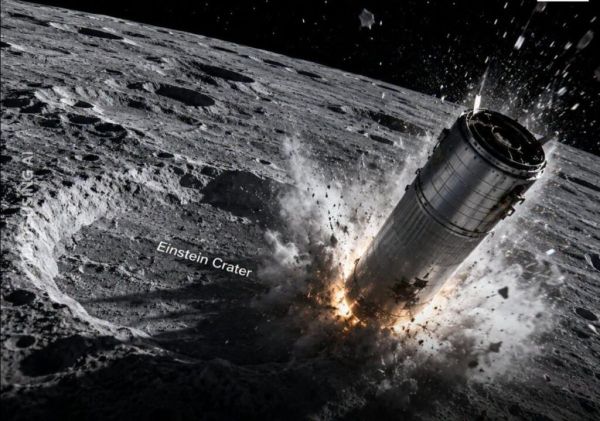
A stray SpaceX Falcon 9 rocket stage has reportedly crashed into the Moon, creating a new crater near the famous Einstein Basin. The object, which had remained in space after completing an earlier lunar mission, struck the lunar surface at an estimated speed of 8,700 km/h. Scientists believe the SpaceX rocket Moon crash could offer a rare opportunity to study how high-speed impacts shape the Moon’s surface.
Why the Moon impact was difficult to witness
The SpaceX rocket Moon crash occurred at around 07:35 BST (06:35 GMT) on Wednesday. However, the impact happened on the Moon’s sunlit side, making it almost impossible to observe from Earth.
Experts said the flash produced by the collision likely lasted only a fraction of a second. Even advanced amateur telescopes had little chance of detecting the event because the Moon is nearly 385,000 kilometres away and the rocket stage measured only about 14 metres.
Scientists also believe the impact may have thrown up a dust plume stretching as far as 100 kilometres across the lunar surface, although this has yet to be confirmed.
Scientists now searching for the new crater
Researchers are now waiting for spacecraft images that could reveal the fresh impact site. NASA’s Lunar Reconnaissance Orbiter is expected to photograph the area in the coming days, allowing scientists to compare before-and-after images to identify the crater created by the SpaceX rocket Moon crash.
South Korea’s Danuri lunar orbiter also passed close to the expected impact zone shortly before the collision. Officials said any images captured by the spacecraft would be released only after researchers complete their scientific analysis.
Powerful telescopes in the Americas may also provide useful observations because skies remained dark there during the time of impact.
Why this collision matters
The SpaceX rocket Moon crash is considered scientifically valuable because researchers already know important details about the object, including its size, speed and expected impact location. Unlike most natural impacts, this gives scientists an opportunity to study the crater almost like a planned experiment.
The findings could improve understanding of how both human-made objects and natural space debris interact with the Moon’s surface, helping researchers refine future lunar impact models.
FAQs
Q1. What caused the SpaceX rocket Moon crash?
A. The impact involved the empty upper stage of a SpaceX Falcon 9 rocket that remained in space after completing a previous lunar mission.
Q2. Where did the SpaceX rocket Moon crash happen?
A. Scientists believe the rocket struck the Moon near Einstein Basin, creating a new impact crater.
Q3. Why was the Moon impact difficult to observe?
A. The collision occurred on the Moon’s daylit side, and the impact flash lasted only a fraction of a second, making it extremely difficult to see from Earth.
Q4. Why is the SpaceX rocket Moon crash important to scientists?
A. Because researchers know the rocket’s size, speed and expected impact location, they can study the new crater to better understand how impacts shape the Moon’s surface.
Contact to : xlf550402@gmail.com
Copyright © boyuanhulian 2020 - 2023. All Right Reserved.