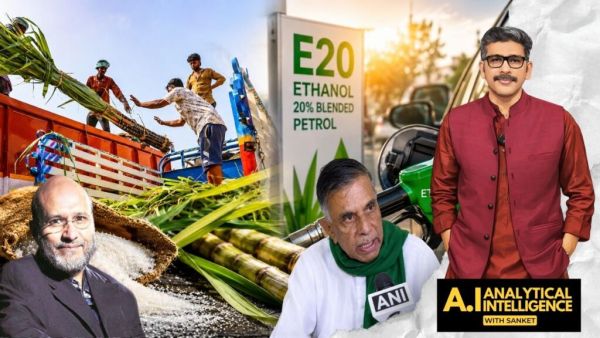
As the E20 fuel debate deepens, a new question is taking centre stage: is India’s push for ethanol coming at the cost of food security?
With domestic sugar prices rising and concerns over supply shortages ahead of the festive season, experts and farmers’ groups are questioning whether the government’s biofuel policy is putting fuel blending ahead of affordable food. Economist Prof. Santosh Mehrotra, visiting professor at the Centre for Development, University of Bath, has called the Centre’s continued E20 push “pigheaded”, while farmer leader Chengal Reddy, Chief Adviser to the Consortium of Indian Farmers Associations, has criticised the diversion of maize, broken rice and sugarcane towards ethanol production.
Food security vs fuel blending
Reddy warned that diverting feed grains such as maize to ethanol plants could create artificial shortages and push up costs for the livestock, poultry and fisheries sectors, with the impact eventually spreading across the food supply chain.
Also read: Sugar price surge puts E20 debate under fresh scrutiny; govt rejects claims
With 40 to 50 per cent of poor women and children in India suffering from widespread malnutrition, Reddy argued that agricultural policy should prioritise affordable food and access to protein over fuel blending. He described the policy as “upside down”, saying underprivileged communities need affordable sugar and other essential food items before fuel.
Reddy also pointed to what he described as a contradiction in government regulation: while sugar prices, exports and imports are tightly controlled, farmers continue to bear high and largely unchecked input costs for pesticides, diesel, tractors and drip irrigation equipment.
Govt rejects ethanol link to sugar prices
The Union government, however, has rejected the argument that ethanol diversion is behind the current sugar price rise. Its official position is that lower production, weather- disruptions and festive demand are primarily responsible for the crunch. Government data show that the share of sugarcane diverted for ethanol fell from 12 per cent in FY 2022-23 to 9 per cent in FY 2025-26.
Also read: Forgotten in ethanol debate: Two-wheelers, not cars, are paying the real price for E20
Independent estimates, however, suggest that as much as 32 per cent of sugarcane and its derivatives could be going towards ethanol production this year.
Countering govt’s explanation
Mehrotra rejected the government’s explanation, arguing that the percentage share alone does not tell the full story. Even if the proportion of sugarcane diverted to ethanol has declined, he said, the absolute volume of ethanol produced across the economy has increased significantly.
He also questioned the government’s reliance on festive demand as an explanation for the shortage. Festive demand, he said, is predictable and follows the Hindu calendar, meaning policymakers should have anticipated the seasonal increase rather than cite it after prices had risen.
Similarly, Mehrotra argued that climate- variations in rainfall are foreseeable risks that should have been factored into policy planning instead of allowing them to disrupt supply while maintaining biofuel targets.
Wider farm crisis
Reddy, meanwhile, expressed strong disappointment with the Centre’s handling of the farm sector, saying the NDA government had failed farmers over the past decade. He pointed out that around 200 sugar factories have shut down across India in the last 10 years, with little meaningful effort to revive them.
Also read: Why is E20 policy report not in public domain if it’s beneficial for India?: Tahseen Poonawala
He argued that sugarcane remains a versatile and profitable crop, capable of producing not just sugar but also bioplastics, molasses and other useful byproducts. Instead of building a sustainable ecosystem around these products, he said, the government has chosen to divert sugarcane towards vehicle fuel — a move he described as a fundamental policy failure, particularly when electric mobility offers an alternative to petrol-based transport.
EVs as an alternative
Mehrotra suggested that if the primary goal of the ethanol policy is to cut crude oil imports, the government should focus on electric vehicles powered by India’s growing solar energy capacity.
With solar accounting for a third of generated electricity and renewables representing 51 percent of installed capacity, expanding EV infrastructure and battery storage offers a more sustainable path for energy transition without compromising food security.
Who really benefits from ethanol?
Addressing the claim that ethanol blending enriches rural households, Reddy stated that the policy is not benefiting real farmers at all, except for select sugar mills in states like Uttar Pradesh that receive higher prices for ethanol production.
The E20 debate goes beyond fuel blending; experts call for an immediate halt to aggressive E20 targets, a renewed focus on solar-powered electric mobility, and policies that safeguard food security over bio-fuel mandates.
Contact to : xlf550402@gmail.com
Copyright © boyuanhulian 2020 - 2023. All Right Reserved.