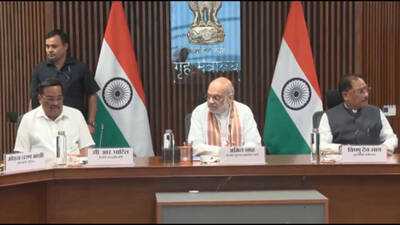
Raipur: The long-running Mahanadi water dispute between Chhattisgarh and Odisha moved a significant step towards a negotiated settlement on Thursday, with chief ministers Vishnu Deo Sai and Mohan Charan Majhi holding high-level talks in New Delhi under Union home minister Amit Shah.
The meeting at Kartavya Bhavan brought the political leadership of both states to the table alongside Union Jal Shakti minister C R Patil, the central water commission chairman, chief secretaries and senior water resources officials.
The discussions assume significance because they run parallel to proceedings before the Mahanadi water disputes tribunal, constituted by the centre in March 2018 after Odisha sought adjudication of the interstate dispute. In recent weeks, the tribunal has allowed space for negotiations as technical teams from both states began working through the CWC on a possible water-sharing framework.
Sai told the meeting that Chhattisgarh was prepared for a “just, scientific and long-term” settlement based on dialogue and transparent assessment of water availability and requirements.
“The Mahanadi is not a river that divides us, but a lifeline that connects both states,” Sai said, adding that any settlement should safeguard the interests of farmers, citizens and future generations on both sides.
At the heart of the dispute is the sharing and use of Mahanadi waters, particularly during the non-monsoon months. Odisha has long maintained that upstream barrages and projects in Chhattisgarh affect flows into the downstream state and Hirakud reservoir , while Chhattisgarh has maintained that it is entitled to utilise water falling within its share of the basin for irrigation, drinking water, industry and development.
Sai reiterated that a major portion of the Mahanadi catchment lies in Chhattisgarh and that the state’s irrigation, drinking water and development requirements, particularly in rural and tribal areas, must form part of any final arrangement.
At the same time, he said Chhattisgarh recognised the importance of Hirakud reservoir for Odisha and was willing to work towards a solution that protected the legitimate requirements of both states.
A key area under discussion is the creation of a transparent mechanism for sharing data on water availability, present and projected use, irrigation, drinking water and environmental requirements.
Technical teams from the two states have already held rounds of discussions under the CWC, examining issues including water availability, upstream projects, basin management, hydrological data and possible principles for water sharing.
The present round of talks builds on a July meeting chaired by Union minister C R Patil, when both chief ministers had agreed to pursue an amicable settlement through dialogue and technical cooperation.
The political push has raised expectations of movement in a dispute that has remained unresolved for nearly a decade. Majhi, after Thursday’s meeting, expressed optimism that a solution could emerge within a month, though any final arrangement would still require agreement on the technical and legal details.
Sai said Chhattisgarh would cooperate with any “just and practical” framework emerging from negotiations between the two states and mediation by the Centre.
The Mahanadi water disputes tribunal continues to remain the legal forum adjudicating the dispute, but the latest meetings indicate that both states are increasingly exploring a settlement outside prolonged litigation.
For Chhattisgarh and Odisha, the next challenge will be turning political consensus into an agreed formula on the river itself — how much water is available, how much each state requires, and how that water should be shared in lean and monsoon seasons.
Contact to : xlf550402@gmail.com
Copyright © boyuanhulian 2020 - 2023. All Right Reserved.