A wonder under the banyan tree. The disciples are old. The guru is young. The guru teaches in silence. And the disciples' doubts are gone.
That is Dakshinamurthy , the first teacher. He said nothing. Everything was understood.
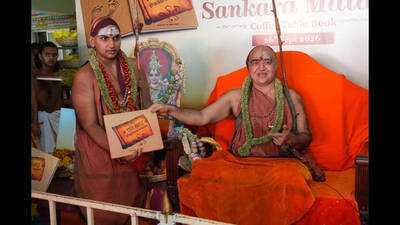
Last week, at Orikkai in Kanchipuram, on the last day of Chaturmasya, Jagadguru Sri Shankara Vijayendra Saraswati Shankaracharya Swamigal turned that image towards this very column. Dakshinamurthy taught in silence under a tree, he said. Today the tree must speak. That is the Speaking Tree.
The occasion was the release of The Holy Shankara Matam , a coffee-table book on the Kanchi Kamakoti Peetham . It began with an old story. In November 1997, The Times of India interviewed the 69th Acharya, Sri Jayendra Saraswati Swamigal , during his Vijaya Yatra. The story mentioned that he was accompanied by his "chief disciple and successor-to-be". Twenty-nine years on, that successor-to-be sits on the Peetham, with his own successor beside him. In a newsroom, we call that a follow-up story. It took us twenty-nine years to file it.
On the dais, it was said that in a digital age, most people who receive a book are satisfied with its cover. A few reach the index. The bulk of the world goes by the critics, who never read it either. A book that stops at the cover only decorates the drawing room.
The Acharya gave the remedy. It is the oldest sequence in our tradition, and the most neglected. First, read. Second, understand what you have read. Third, practise what you have understood. Only then, fourth, propagate. "Some begin their work with propaganda," he said. "We begin ours with study. That is the difference between the spiritual life and every other field."
For a newspaper, this sequence is familiar. Our trade is the fourth step. We publish every morning. But in the age of AI, it lands with force. A print journalist earns the fourth step by walking through the first three: read, verify, understand, then publish. AI skips straight to the fourth. The Acharya was speaking of dharma. He could just as well have been writing our newsroom manual. 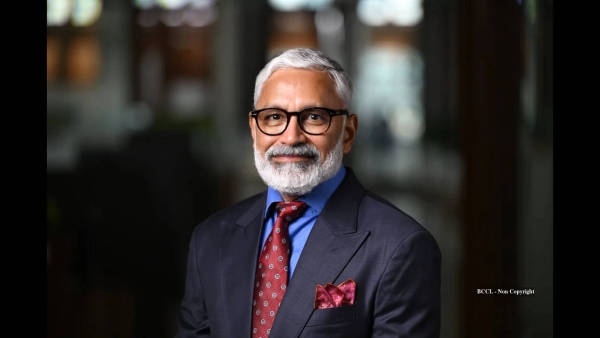
He then took up the word that makes every sanyasi a little uneasy: coffee. Here at Orikkai, he recalled, in 1954 and 1955, when the young Jayendra Saraswati Swamigal was being trained, there was a serious debate on the subject.
So he gave the word a new meaning. Coffee, kaapi in Tamil, is close enough to copy. When scholars take an impression of a temple inscription, they call it padi eduthal, “taking a copy”. This book, then, is a copy of the Kanchi Matam. A reflection of it. And a reflection belongs where people gather: at railway stations, airports, hotels, the places where we stop for a cup of coffee. Where lawmakers, profit-makers, and policy-makers wait for their flights. That is where good ideas must be placed, so that good people may find them.
There was a tender moment, too. In our welcome address, we had recalled how the Maha Periyava learnt that a branch of the Atharva Veda survived with a single scholar in Gujarat, and sent students from the South to learn it before it was lost. The Acharya took up the story. That one family, he told the gathering, has become more than two hundred families, and the Atharva Veda is chanted there today. In finance, we call it investment, he said. The Maha Periyava invested time and a strategy. The returns are still coming in.
And then, as Acharyas do, he handed us homework. The scholars of the Matam, of the Sri Chandrasekharendra Saraswathi Viswa Mahavidyalaya, and of the new centres for Tarka, Mimamsa, Vedanta and Jyotisha are right here in Kanchi, he said. Let them become a source for this column, the way PTI, UNI and Reuters are for the news pages. From Kanchi, history, shastra and art for the whole of the media.
We came to release a book. We left with an assignment. That is usually how it goes with a Guru.
Our phones keep us looking down all day. The gopuram was built so that we would look up. A book, if it is read, sits somewhere between the two. It will not give us the experience. The 69th Acharya once told our readers that moksha is like the taste of misri. It cannot be described. It must be tasted. At best, a book brings us to the door.
The silent teacher under the banyan needed no words. The rest of us do. So let the tree speak. And let us, for once, do the reading first.
Authored by: Sivakumar Sundaram
Contact to : xlf550402@gmail.com
Copyright © boyuanhulian 2020 - 2023. All Right Reserved.