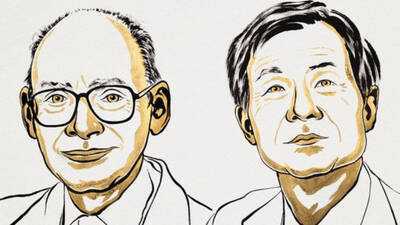
France's Henri Kagan, Japan's Kenso Soai win 2026 Nobel Chemistry Prize for research solving 'mirror image' mystery
The 2026 Nobel Prize in Chemistry has been awarded to France's Henri B. Kagan and Japan's Kenso Soai “for the discovery of non-linear effects and autocatalysis in asymmetric organic synthesis ,” the Nobel Committee announced.
Kagan and Soai were discovered how how homochirality can emerge spontaneously. Some molecules, including amino acids, exist as two mirror-image variants, but organisms contain only one. For decades, chemists struggled to understand how this asymmetry could arise.
Kagan made a breakthrough in 1986 by finding a way to manipulate reactions to produce an excess of one mirror image. Soai designed a reaction with the potential to become homochiral in 1995 and, in 2003, achieved a reaction that formed only one mirror image. Their discoveries have been decisive for pharmaceutical manufacturing.
Discovery by Kagan and Soai
The Nobel Prize in Chemistry 2025 was awarded jointly to Susumu Kitagawa, Richard Robson and Omar M. Yaghi "for the development of metal–organic frameworks".
The metal-organic frameworks (MOFs) are ultra-porous crystalline sponges link metal ions with organic molecules. Their breakthrough allows scientists to trap and manipulate molecules, driving critical technologies that capture carbon, store green hydrogen, and harvest fresh drinking water directly from desert air.
The Nobel Prize in Chemistry is awarded annually as part of the Nobel Prizes established under the will of Swedish inventor and industrialist Alfred Nobel.
Nobel, who made his fortune through inventions including dynamite, specified that prizes should be awarded to those who had made the “greatest benefit to humankind” in five fields: Physics, Chemistry, Physiology or Medicine, Literature and Peace.
Chemistry was included because of its central role in Nobel’s own scientific and industrial work.
The Royal Swedish Academy of Sciences selects the Chemistry laureates. The prize was first awarded in 1901, with Dutch chemist Jacobus Henricus van ’t Hoff becoming its inaugural recipient for his work on chemical dynamics and osmotic pressure.
The award recognises major discoveries or advances in chemistry that have significantly contributed to scientific knowledge and society.
Kagan and Soai were discovered how how homochirality can emerge spontaneously. Some molecules, including amino acids, exist as two mirror-image variants, but organisms contain only one. For decades, chemists struggled to understand how this asymmetry could arise.
Kagan made a breakthrough in 1986 by finding a way to manipulate reactions to produce an excess of one mirror image. Soai designed a reaction with the potential to become homochiral in 1995 and, in 2003, achieved a reaction that formed only one mirror image. Their discoveries have been decisive for pharmaceutical manufacturing.
Discovery by Kagan and Soai
The Nobel Prize in Chemistry 2025 was awarded jointly to Susumu Kitagawa, Richard Robson and Omar M. Yaghi "for the development of metal–organic frameworks".
The metal-organic frameworks (MOFs) are ultra-porous crystalline sponges link metal ions with organic molecules. Their breakthrough allows scientists to trap and manipulate molecules, driving critical technologies that capture carbon, store green hydrogen, and harvest fresh drinking water directly from desert air.
The Nobel Prize in Chemistry is awarded annually as part of the Nobel Prizes established under the will of Swedish inventor and industrialist Alfred Nobel.
Nobel, who made his fortune through inventions including dynamite, specified that prizes should be awarded to those who had made the “greatest benefit to humankind” in five fields: Physics, Chemistry, Physiology or Medicine, Literature and Peace.
Chemistry was included because of its central role in Nobel’s own scientific and industrial work.
The Royal Swedish Academy of Sciences selects the Chemistry laureates. The prize was first awarded in 1901, with Dutch chemist Jacobus Henricus van ’t Hoff becoming its inaugural recipient for his work on chemical dynamics and osmotic pressure.
The award recognises major discoveries or advances in chemistry that have significantly contributed to scientific knowledge and society.
Contact to : xlf550402@gmail.com
Copyright © boyuanhulian 2020 - 2023. All Right Reserved.