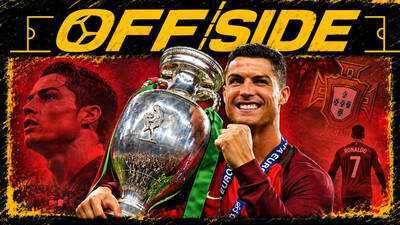
Albert Einstein showed beyond doubt that time wasn’t absolute, as Isaac Newton believed – trust a former German citizen to ruin an Englishman’s conception of the universe – but for now, without access to vehicles that move at the speed of light, the absolute and linear concept of time is the only human experience that exists without taking psychedelic substances. And sadly, that means slowly, the greats who have defined the last two decades of sports are slowly being put out to pasture in retirement. In tennis, Roger Federer and Rafael Nadal – two gentlemen who redefined both the game and the art of being gentlemen – have hung up their rackets. We will never see their contrasting games – Renaissance painter with a racket vs a Davidian sculpture made with a chisel – ever come up against one another. The same goes for football, where Lionel Messi and Cristiano Ronaldo have now both hung up their international footballing boots.
Both careers played out in the Age of Social Media, and much has been written – even in Offside – about Ronaldo’s insouciant petulance in the last days of his career, but remembrances should be about good things, not bad ones.
In earlier editions of Offside, we have argued that , written about , and lamented . This time, we will remember the happiness he gave us.
For once, let’s stop being captivated by the carousel of constant negativity and remember what the boy from Madeira – that’s closer to Morocco than Lisbon – meant to Portugal as a player.
Now, much has been written about his numbers. Ronaldo has scored in six World Cups and five Euros, and has scored in 23 consecutive years. Of Portugal’s total goals at major tournaments, he has scored 19.2 per cent. There’s a very clear Portugal before Ronaldo, which, despite the likes of Luis Figo and Co, barely made a dent in tournaments, and a Portugal after Ronaldo, which looked like a team of substance.
It’s also unlikely – unless Romelu Lukaku or Harry Kane go on Ronaldo-like scoring sprees – that anyone will beat his record of 146 international goals. But football isn’t about numbers: little kids don’t dream of xGs but of how the beautiful game makes us feel.
There are moments in the Ronaldo highlight reel where fans and the wider footballing public were drawn in by the remarkable drama that followed.
Like Euro 2004 – the same year his future Manchester United wingman and footballing soulmate Wayne Rooney burst onto the stage – when Ronaldo wept after losing to Greece in the final. Or the World Cup two years later, when Ronaldo winked at his bench after ensuring Rooney got sent off for playing with a different set of balls – before dispatching the penalty that knocked England out of the World Cup. He would come back as Public Enemy Number 1 in the UK, something that the wily Sir Alex Ferguson used to his advantage to forge the world-beating generation of Ronaldo and Co, including the 2008 Ballon d’Or that fans voted the greatest Ballon d’Or of all time.
Or when he sat heartbroken – a moth fluttering over his nose after he got injured – as Portugal somehow pulled through to beat France in the Euro 2016 final that became as famous for Ronaldo’s managerial theatrics as it did for Portugal’s first major trophy. And then, while going to collect the trophy, he spotted Sir Alex, who hugged him like a Biblical prodigal son returning home.
Or the 2014 World Cup qualifier showdown between Ronaldo and Zlatan – when Portugal met Sweden – which saw Ronaldo drag Portugal into the World Cup by sheer willpower.
Then there was 2018, when one hat-trick appeared to cause a glitch in David de Gea’s goalkeeping algorithm – before that he was impossible to beat, and afterwards he kept getting beaten like Onana – in which Portugal drew 3-3 with Spain.
The man named after Ronald Reagan would turn up for his nation whenever required, scoring when everything looked lost, and would add two UEFA Nations League titles. Yes, his tantrums would be panned on social media; at times, his overall global fame perhaps became detrimental and overshadowed the Portuguese national team’s fortunes.
But there’s no doubt that because of Cristiano Ronaldo, Portugal became the team to watch and support for millions of fans across the globe.
When Ronaldo first played for Portugal in August 2003, he came on as a substitute for Luís Figo, the man who was then the country's greatest footballing superstar. Ronaldo would eventually inherit Figo's No. 7 shirt, a number already associated with Portuguese footballing greatness.
While Figo crossed the Barcelona-Madrid divide and got a pig’s head thrown at him for his lack of loyalty, Ronaldo, after winning everything with Manchester United, became the world’s most expensive footballer when he joined Real Madrid, which seems like a bargain at GBP 80 million, making him slightly cheaper than what Manchester United paid for Antony. During his time in Madrid, he won four Champions Leagues and well surpassed Figo’s record there. His shirt became one of the most recognised in the world.
In his retirement announcement, Ronaldo spoke about handing back the No. 7 shirt, which he had worn for 23 years. It was a rather poignant admission from a man who had spent much of his career appearing almost invincible. The shirt that once belonged to Figo, and then became synonymous with Ronaldo, will now belong to someone else.
When Ronaldo inherited Figo’s shirt, an entire generation of football fans was still growing up. Those same fans are now adults, many with children of their own, who have spent their lives watching Ronaldo defy age, expectations and occasionally common sense. For them, his retirement also marks the end of a part of their own lives.
There will be other great Portuguese footballers, other No. 7s and perhaps even someone who breaks Ronaldo's extraordinary records. But the next player to wear that shirt will inherit an enormous burden of expectations. The No. 7 shirt has become something of a poisoned chalice at Manchester United since Ronaldo left for Madrid, and it proved to be a burden even for Ronaldo himself when he returned. Hopefully, it won’t become an albatross for the next Portuguese player who puts it on.
Ronaldo’s footballing legacy will outlast the goals he has scored, the appearances he has made and the trophies he has won with club and country. Go to any corner of the world and you’ll find some random kid leaping into the air and copying his celebration. And that is something no statistic can measure. Einstein showed us that time isn’t absolute. We still don’t have a time machine or a way to travel at anything close to the speed of light. But watch those old Ronaldo highlights from our youth, and for a few fleeting moments, the years seem to disappear. We are young again, watching the man who gave us so much happiness. And we all go SIUUU.
Contact to : xlf550402@gmail.com
Copyright © boyuanhulian 2020 - 2023. All Right Reserved.