
Kolkata: A funding crunch and mounting stress in short cycles in India's microfinance sector are forcing a growing number of smaller lenders to retreat from direct lending and turn into business correspondents for banks, signalling a structural shift in an industry built on the joint-liability group lending model.
As access to bank funding and fresh equity dries up, many practitioners are opting for off-balance-sheet growth, while questioning the relevance of a model pioneered by Chandra Shekhar Ghosh and Vijay Mahajan, especially when borrowers have multiple formal credit options and rising aspirations.
"I have never been better," said Alok Biswas, who built in August 2025 for working as business correspondent of banks. "I no longer have to chase bank funding for onlending. Banks are reluctant to lend to small microfinance companies while they are ever ready to give money to business correspondent partners for directly lending to the bottom of the pyramid segment," said Biswas, who left in 2010 to build Jagaran Microfin and later in 2016, another micro lender Janakalyan Finance Services. 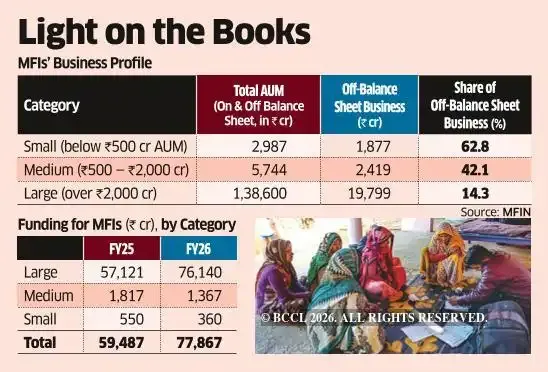
Several of Biswas's peers and rivals are exploring the off-balance sheet exposure following the subsequent stresses in the sector starting from the pandemic-led disruptions.
, facing cash flow stress, is the latest entrant in the business correspondent play. The company with below investment grade rating is unable to borrow from banks, forcing it to open a business correspondent vertical and work as banks' agents in the field to keep the revenue flow going as a fee income.
Anjan Dasgupta, former head of the now defunct Asa International India Microfinance, set up Solis Ortis BC in April 2025 to partner banks and non-banks and deliver loans to underserved individuals, farmers and MSMEs. "The expiry date of the traditional microfinance model is over," Dasgupta said. "Clients' aspirations have changed. Gone are the days when women in groups used to come to meetings and plead for loans. The emergence of digital lending eased the process of tapping varied sources of institutional funds for the new generation bottom of the pyramid customers."
Sectoral leaders say they now use the groups barely as an entry point to give access to institutional finance while focussing on upgrading borrowers as individual customers. "Microfinance is no longer a distribution game. It's a capital game," said chief executive .
Data from showed that small and medium MFIs with outstanding portfolios below ₹2,000 crore received 27% less funding in FY26 of ₹1,727 crore.
Contact to : xlf550402@gmail.com
Copyright © boyuanhulian 2020 - 2023. All Right Reserved.