According to the National Institute of Urban and Rural Planning (VIUP), a consultant for Ho Chi Minh City’s 100-year master plan, the central challenge facing the expanded city is to restructure urban space, redistribute resources and connect its growth centers into an integrated system. The former Ho Chi Minh City was the country’s economic engine, but its capabilities in research and development, core technologies and the commercialization of innovation had not kept pace with its economic standing. Binh Duong had a substantial industrial base, but foreign-invested enterprises accounted for more than 80% of its exports. Vung Tau recorded high gross regional domestic product (GRDP) per capita, but its economy remained heavily dependent on oil and gas, seaports and natural advantages.
Following the merger, the expanded Ho Chi Minh City has a much larger economic base. However, it has yet to transition quickly enough toward a growth model driven by productivity, technology, highly skilled workers and strong domestic enterprises, according to the consulting team preparing the city’s 2025-2050 master plan. The city also faces the risk of falling into the middle-income trap if it continues to rely heavily on expansion in scale, foreign direct investment (FDI), land, labor and industries with relatively low added value.
To address these limitations, the expanded city is expected to bring together three complementary sets of strengths. The former Ho Chi Minh City will serve as a center for finance, services, commerce, innovation and markets. Binh Duong will provide the industrial manufacturing base and industrial urban infrastructure. Vung Tau will serve as a gateway for deep-water ports, logistics, energy and the maritime economy. Together, these three components are intended to create a complementary structure linking the service core, manufacturing base and international gateway. This combination is expected to support specialized industry clusters in finance, high-tech manufacturing, port logistics, energy, the maritime economy and tourism.
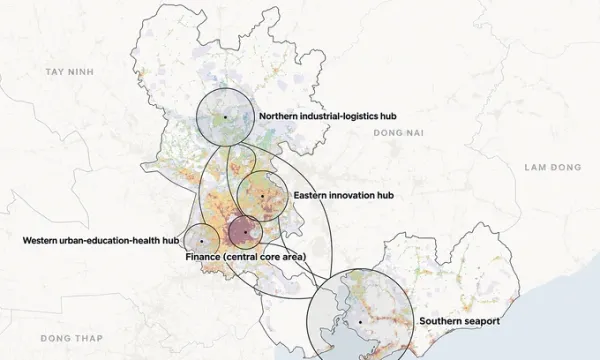
Building on these strengths, Ho Chi Minh City’s 2025-2050 master plan, with a 100-year vision, aims to transform the expanded city from a collection of separate local assets into an integrated economic region. The plan is organized around a 5-5-5-10 framework.
The first component consists of five growth poleswhere resources are concentrated to drive economic development. Supporting these growth poles are five satellite centersdesigned to distribute residents, jobs, and services rather than concentrating them in the urban core. The growth poles and satellite centers are connected through five strategic linkage systems. These systems form the framework connecting growth poles, satellite centers, and functional zones, facilitating the movement of goods, capital, knowledge, tourists, data, energy, and water, while maintaining ecological connections.
The entire city is divided into 10 development management zones. Each zone is a functional area managed according to its land conditions, infrastructure, environment, local identity, and specific development control requirements. Presenting the master plan to the Ho Chi Minh City People’s Council on Oct. 29, Vice Chairman of the municipal People’s Committee Nguyen Manh Cuong said the 10 zones would provide the basis for organizing urban space and distributing population, employment, infrastructure, and resources according to each area’s function and natural conditions.
According to the planning documents, the framework goes beyond dividing the city into development areas. It also establishes investment priorities, determining which locations should receive investment first and which should remain subject to long-term development controls.
The five growth poles are designed to serve as the megacity’s principal economic engines, each building on the existing strengths of its respective area.
Contact to : xlf550402@gmail.com
Copyright © boyuanhulian 2020 - 2023. All Right Reserved.