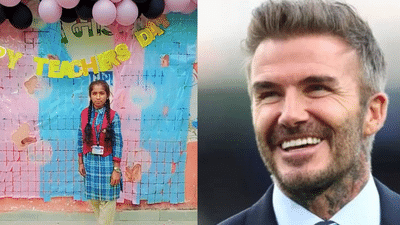
INDORE: “Studying is difficult, but whatever challenges come my way, I have to keep going.” For 17-year-old Hima Ninama , this resolve translates into a 10-km daily commute on foot, a journey made harder by her physical disability .
Every school day, the Bhil tribal girl walks five kilometres from her home in Barkheda village of Jhabua district to reach the point where her school bus picks her up, and walks another five kilometres back in the evening. Often alone, she has learnt to make this journey a part of her life, unwilling to let the distance or the challenges of walking keep her out of the classroom.
That determination is also what led Hima to challenge her family’s decision to marry her off when she was studying in Class 11. Her story, documented by UNICEF India, was shared on World Children’s Day by former England football captain and UNICEF goodwill ambassador David Beckham , bringing her struggle to continue her education to an international audience.
But behind the viral story is a girl who had to seek help to retain something many take for granted — the right to decide whether she would study or marry.
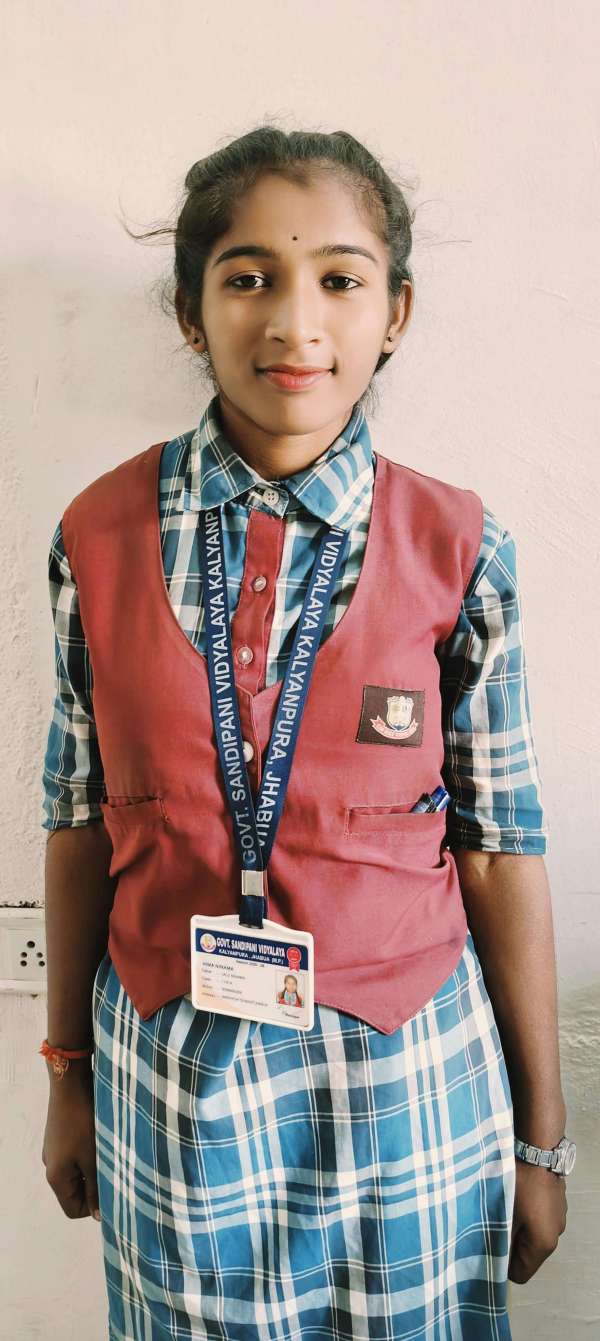
“When Hima was in Class 11, she came to me and said, ‘Sir, my father wants to get me married. Please help me’,” said Gyanendra Prasad Ojha, her school principal. He called her father to school and tried to persuade him to reconsider. “But he said, ‘Man liya hai humne ki shadi karenge (We have decided that we will get her married).’ I told him, ‘Ladki nahi karna chahti hai (The girl does not want to get married)’.”
Ojha said Hima wanted to become a teacher and help children in her community progress. Her father, however, questioned how she would manage given her physical disability.
“I explained that there are many people with disabilities who achieve things. He was initially not convinced, so I called other teachers and had them speak to him as well. We counselled him and eventually convinced him,” he said.
Hima’s determination, Ojha said, extends to everything she takes up. Despite a physical disability affecting her right leg and hand, she participates in shot put using her left hand, drawing and other competitions, securing top positions at the district level.
“She wants to give her best and puts in the effort,” he said.
The family, meanwhile, has little to spare. Hima’s parents are illiterate and work as daily-wage labourers while also cultivating a small patch of land. She did not even have slippers when she came to school, Ojha said. The school arranged shoes and had her uniform stitched to suit her physical requirements. “We did it just as we would for our own daughter,” he said.
Hima said she wakes up at 5.30 am, helps with cooking and household chores and leaves around 9.30 am. She reaches the bus point around 10 am, often alone, as the other children there attend different schools.
“Walking long distances is difficult for me. Sometimes I feel lonely, but I have got used to it because I have to go to school in any situation,” she said. She rarely takes leave unless unavoidable.
Her mother, Kashma, works in the fields, and Hima joins her in the mornings and on Sundays. The family grows cotton, maize and soybean. Her 16-year-old sister, Soniya, had also left home and got married while studying in Class 9.
Hima, however, wants a different future. “I want to become a primary school teacher . I like teaching children. Studying is difficult, but I am continuing,” she said.
The attention brought by Beckham’s post made her happy, she said, but the support from her school has mattered just as much. “UNICEF made a video, and my school has supported me in continuing my studies. It has given me courage. I feel I now have the freedom to study,” she said.
Contact to : xlf550402@gmail.com
Copyright © boyuanhulian 2020 - 2023. All Right Reserved.