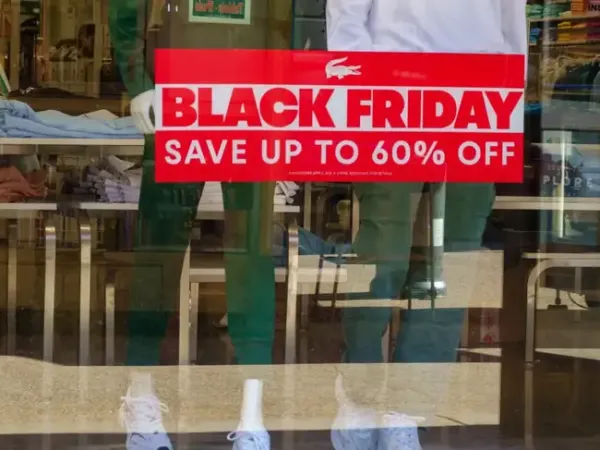
New Delhi | Mumbai: Black Friday sales were up to 30% higher than last year partway through the day, with discounts and other promotions being pitched by brands, retailers, grocery platforms and other sellers through the week to clear unsold inventories, multiple executives told ET. That's unlike previous years, when the price incentives were mostly for just Friday.
Categories ranging from phones, apparel, vacations, household goods and beauty are leveraging the November event with discounts of 30-50% amid uneven demand during the festive period, extending the season even beyond the weekend and to tier 2 and 3 markets.
Also Read: India’s Black Friday Sale euphoria moves from shelves to the skies
"Our exclusive retail channel has seen a 30% increase in sales (in the days to Black Friday) compared to the same period last year, driven by increase in consumer footfalls," said Sudhir Jatia, managing director at luggage and travel accessories maker Safari Industries. "Mall stores have witnessed stronger traction compared to high-street outlets, highlighting the growing relevance of organised retail spaces during sale periods."
The event, which copies a Western practice, occurs on the Friday after Thanksgiving and is followed by Cyber Monday.
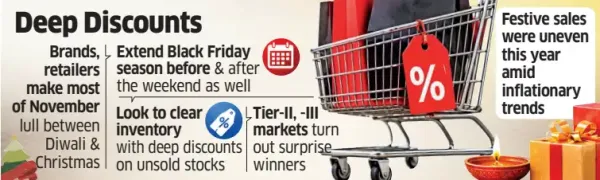
It fills a gap in India's retail calendar, since Diwali traditionally leads to the most significant consumption spike in the year, followed by a relatively quieter period before Christmas and year-end sales, executives said.
"Brands that have excess stocks have been offering deeper discounts of buy-one-get-one or buy-two-get-one-free over the last one week," said Biju Kassim, managing director at Global SS Beauty Brands, owned by fashion and beauty retail chain Shoppers Stop.
 Executives said brands are pushing further discounts as the period coincides with peak wedding shopping season. "Beyond immediate sales, Black Friday serves as an important bridge between the festive season and the year-end shopping period, helping sustain retail momentum," said Pushpa Bector, group executive director and business head at DLF Retail, which operates malls and retail plazas such as DLF CyberHub, Horizon Plaza and Emporio in Delhi NCR.
Executives at malls said footfalls through the week have been about 25% higher than a regular weekend.
"A lot of these western concepts have come in and we were also surprised at how well they are doing. Mostly, it's an opportunity (for brands) to clear inventory," said Mukesh Kumar, chief executive at Infiniti Malls. "Before Christmas and New Year, Black Friday is the last window for a discount sale, so it gets a lot of traction. Black Friday has extended - this year, some companies are extending discounts to the following week as well."
Also Read: Black is good for Indian companies to make more money
Another development is Black Friday sales gaining traction in towns and smaller cities, with brands and platforms such as H&M, Fabindia, Decathlon, Nykaa, Amazon, The Body Shop and Chumbak wooing tier 2 and 3 shoppers as well.
According to ecommerce tech platform GoKwik, spending on India's direct-to-consumer brands rose 63% in the first 12 hours of this year's Black Friday sale, driven by shoppers in smaller cities. Shoppers outside India's eight largest metros accounted for 61% of total spending, with their expenditure rising 66% from a year earlier. Spending in metros grew 58%. Orders rose 55% year-on-year to 2.38 lakh involving about 226,000 shoppers.
Categories ranging from phones, apparel, vacations, household goods and beauty are leveraging the November event with discounts of 30-50% amid uneven demand during the festive period, extending the season even beyond the weekend and to tier 2 and 3 markets.
Also Read: India’s Black Friday Sale euphoria moves from shelves to the skies
"Our exclusive retail channel has seen a 30% increase in sales (in the days to Black Friday) compared to the same period last year, driven by increase in consumer footfalls," said Sudhir Jatia, managing director at luggage and travel accessories maker Safari Industries. "Mall stores have witnessed stronger traction compared to high-street outlets, highlighting the growing relevance of organised retail spaces during sale periods."
The event, which copies a Western practice, occurs on the Friday after Thanksgiving and is followed by Cyber Monday.
It fills a gap in India's retail calendar, since Diwali traditionally leads to the most significant consumption spike in the year, followed by a relatively quieter period before Christmas and year-end sales, executives said.
"Brands that have excess stocks have been offering deeper discounts of buy-one-get-one or buy-two-get-one-free over the last one week," said Biju Kassim, managing director at Global SS Beauty Brands, owned by fashion and beauty retail chain Shoppers Stop.
Deep discounts
Executives at malls said footfalls through the week have been about 25% higher than a regular weekend.
"A lot of these western concepts have come in and we were also surprised at how well they are doing. Mostly, it's an opportunity (for brands) to clear inventory," said Mukesh Kumar, chief executive at Infiniti Malls. "Before Christmas and New Year, Black Friday is the last window for a discount sale, so it gets a lot of traction. Black Friday has extended - this year, some companies are extending discounts to the following week as well."
Also Read: Black is good for Indian companies to make more money
Another development is Black Friday sales gaining traction in towns and smaller cities, with brands and platforms such as H&M, Fabindia, Decathlon, Nykaa, Amazon, The Body Shop and Chumbak wooing tier 2 and 3 shoppers as well.
According to ecommerce tech platform GoKwik, spending on India's direct-to-consumer brands rose 63% in the first 12 hours of this year's Black Friday sale, driven by shoppers in smaller cities. Shoppers outside India's eight largest metros accounted for 61% of total spending, with their expenditure rising 66% from a year earlier. Spending in metros grew 58%. Orders rose 55% year-on-year to 2.38 lakh involving about 226,000 shoppers.